Clinical Intake Workflow Automation
A multilingual clinical intake platform designed to standardize patient history collection, reduce administrative bottlenecks, and improve the quality of information physicians receive before the visit begins.
Overview
PreVisit AI was the core product developed under Ammonis, a startup I co-founded with two partners from September 2025 to January 2026. The goal was to automate repetitive and time-consuming portions of the patient intake process before the physician entered the room. The software guided patients through a comprehensive conversational intake, generated a structured visit summary for the physician, and supported cleaner downstream documentation in the EMR. The longer-term product vision also included a hardware component to automatically gather vitals such as temperature, heart rate, blood pressure, and weight to further standardize the pre-visit workflow.
My role focused on product and process development, including workflow mapping, bottleneck identification, operational requirements gathering, and hardware concept development for the in-clinic intake station. This aligned closely with the process-oriented work on my resume, where I focused on identifying manual steps, translating operational pain points into requirements, and prototyping a hardware-assisted intake concept.
The Challenge
Patient intake in many clinics is still fragmented across multiple manual steps. Medical history collection, symptom clarification, vitals gathering, and documentation are often spread across staff and systems, which can create delays, inconsistency, and administrative burden before the physician visit even begins.
The challenge was to identify where automation could create the most value without disrupting the care experience. The solution had to be easy for patients to use, useful for physicians, compatible with existing workflows, and structured enough to improve intake consistency rather than add complexity. It also needed to support multilingual communication, produce clean summaries that physicians could actually use, and eventually connect software-driven intake with hardware-enabled vitals capture in one integrated workflow.
Approach
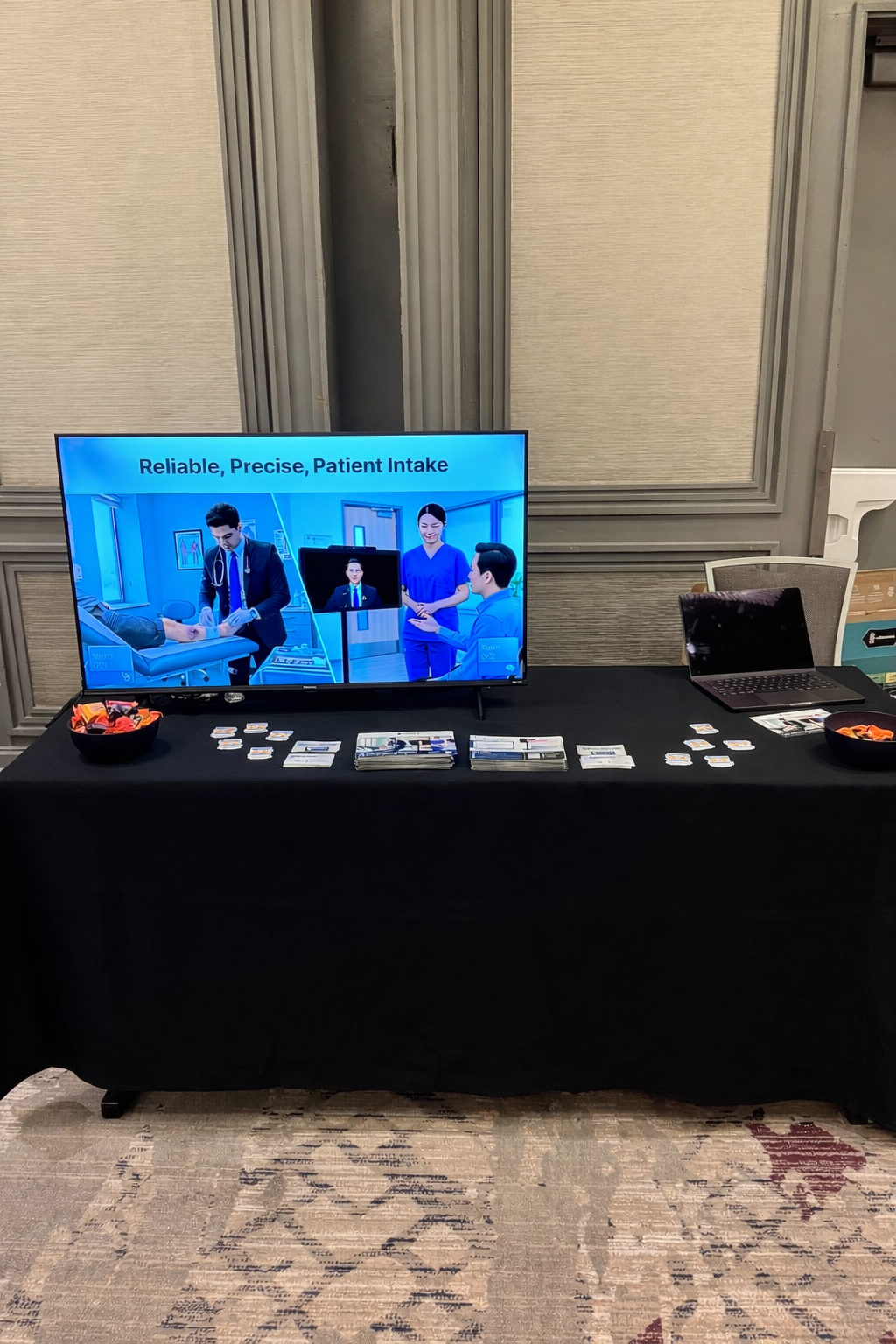
The earliest version of the product explored a talking head concept, where an AI-generated doctor avatar would speak with patients and conduct the intake conversation. We used that version while sponsoring GAACP, where we had the opportunity to position the company alongside major healthcare organizations and speak with hundreds of physicians and several clinic owners.
That feedback was one of the most important parts of the project. We learned that visual novelty mattered far less than clarity, trust, usability, and operational fit. Based on those insights, we pivoted away from the talking head and moved to a more practical conversational AI interface that displayed live text on screen and used visuals to help patients identify and explain symptoms more clearly.
My work centered on the process and systems side of the product. I mapped clinic intake workflows to identify bottlenecks, manual administrative steps, and the best points for automation. I also gathered feedback from clinics and physicians to translate operational pain points into product, workflow, and integration requirements. In parallel, I developed the hardware concept for an in-clinic intake station, including concept development, CAD, part selection, and prototype testing using low-cost sensors and microcontroller-based interfacing to convert readings into a format that could eventually feed into the AI workflow. While the prototype did not reach full reliability, it served as an early engineering validation of how automated vitals capture could extend the software system into a broader intake platform.
The software was designed to support privacy-conscious clinical workflows, multilingual voice-based intake, EMR-connected physician summaries, and a more standardized intake experience for both patients and providers.
Key Decisions
- Pivoted based on direct customer feedback — After speaking with hundreds of physicians and multiple clinic owners at GAACP, we moved away from the animated doctor concept and focused on a simpler interface that better matched real clinical needs.
- Focused on workflow improvement over AI novelty — We positioned the product as a tool to improve intake quality, reduce friction, and standardize information capture rather than as a flashy AI demo.
- Validated software workflow before scaling hardware — We focused first on proving the core intake workflow through software and pilots before investing more heavily in the harder hardware and regulatory path.
- Designed for multilingual clarity — The system supported six languages, helping reduce confusion and making the intake experience more accessible for patients who preferred to communicate in languages such as Mandarin and Spanish.
- Used hardware as a systems extension — The vitals capture concept was treated as an extension of the overall intake process, integrating structured patient history and sensor-based measurements into one workflow rather than as a separate gadget.
Results
PreVisit AI was piloted in three clinical environments: one in Naples, Florida, one in Vancouver, BC, and one with a Florida-based telehealth clinic. Across those pilots, the product helped create cleaner and smoother intakes, saved a notable amount of front-end visit time, and produced structured summaries that physicians found useful in their documentation workflow. Physicians responded positively to the cleaner output and improved handoff into the visit, while patients reported feeling more heard during the intake process.
The multilingual capability created clear value by allowing patients to speak in their preferred language, improving comprehension and reducing confusion during history collection. Outside the pilots, the company gained additional visibility through GAACP, received interest from healthcare groups including Wellstar in Georgia, and was invited to spend three weeks building at Founders Inc. in San Francisco.
Although the company ultimately did not secure funding and the healthcare sales cycle proved too long to sustain the business, the experience was a strong demonstration of workflow analysis, pilot-based iteration, process design, early-stage prototyping, and systems thinking in a regulated environment.